
Sources for Los Banos Previous Residents
A house-history search needs an era chart before it needs a long name list. The table shows what each Los Banos source can contribute and where access changes. Deeds follow owners. Directories and census schedules follow households at intervals. Permits follow work. Vital, newspaper, obituary, and probate records can explain a move, death, or transfer.
| Source | Years it covers | Where held | What it shows |
|---|---|---|---|
| Recorder online index | 1963-present | RecorderWorks | Indexed parties, documents, dates, references |
| Recorder manual indexes and books | Pre-1963; first surviving book to verify | Merced counter | Grantor, grantee, deed and legal-description trail |
| County and city directories | 1877 business; selected Polk years 1914-1989 | Museum and library | Occupant, spouse, occupation, address |
| Federal census | 1850-1950 public under the 72-year rule | NARA, library, genealogy databases | Household at an enumeration snapshot |
| Building permits | Retention and online start not published | Los Banos Building or county Accela | Construction, remodel, demolition chronology |
| Vital and newspaper sources | Coverage varies by series | Recorder, CDPH, library, museum | Kin, death, move, affiliation, or endpoint |
Start with the address form that is known today, but save every historic form as the trail moves back. The current street string may not be the old legal identity of the land.
Start Los Banos House History With APN
Normalize the current situs address using Merced County property guidance. Try the number, omit Street or Road, shorten a direction, and scroll when an exact match fails. Capture the APN, situs, mailing address, parcel map, subdivision or lot, and jurisdiction. An APN is an assessor key, not a title document, but it gives the trail a stable place to begin.
Open the GIS parcel map and compare the polygon with the street, corner, and neighboring lots. Then inspect the assessment and tax record. A mailing address may be an owner, trust, agent, business, or post-office line. It can differ from the situs, and neither line proves that every resident lives there. Save the legal description because it often survives a street label change.
The county's property and survey resources can connect current parcel work to recorded maps, corner records, government townships, and unusual west-side descriptions. A house-history trail becomes much easier when the same APN and legal words recur across the map, deed, permit, and directory notes.
Trace Los Banos Owners Through Deeds
The deed chain is a backward path from today's recorded owner, not a search for every past occupant. Use the assessor or tax record to identify the current owner and APN. Then search that owner as a grantee in RecorderWorks, locate the acquisition deed, and carry its grantor, legal description, and recording reference into the next search. The chain goes from former buyer to earlier seller one instrument at a time.
- Pull the current parcel, owner or assessee, APN, and legal description.
- Search the current owner as grantee and record the purchase instrument, date, document number, and parties.
- Search the seller as grantee for the prior purchase, using the legal description or APN when the street name fails.
- Repeat backward through the January 1, 1963 online cutoff and save every historic address form.
- Move to Merced's manual indexes and deed books for the pre-1963 part of the chain.
- Grantor
- The party transferring an interest in a recorded instrument.
- Grantee
- The party receiving an interest in that instrument.
- Chain of title
- The linked sequence of transfers that explains how an interest moved from one party to another.
- Legal description
- The formal land identity that controls when a street address is new, changed, or absent.
Use both married and former names, trust and entity names, and the legal description. A deed index can find the reference, while the image or kiosk view can show vesting, return address, APN, signatures, and the land language needed to continue.
Cross the 1963 Los Banos Records Divide
RecorderWorks begins exactly January 1, 1963. It supplies index data but not online document images. The public kiosk at 2222 M Street provides free viewing, while mail or email image orders and certified copies carry charges. Before 1963, the search shifts to the Merced counter, bound or digitized grantor and grantee indexes, and deed books.
This unusual cutoff changes the shape of previous-resident research. A free web result may name a deed but hide the legal description that joins it to an older parcel. A kiosk visit may reveal the return address, vesting line, or prior legal description that a shallow web search misses. Use the county's copy-order page for the exact order identifiers and current payment route.
The RecorderWorks page documents the 1963 online boundary and the county's index access path. The complete deed still requires the county's kiosk or order channel.
Build a Los Banos Past-Resident Chart
Once the deed chain is in hand, add the household layer without mixing proof. Use the verified directory years as dated occupant clues, census years as household snapshots, permits as physical-change markers, and vital or obituary records as life-event clues. The result is a chart with gaps, not a smooth story invented between records.
| Era or source | Best question |
|---|---|
| 1877 and 1884-85 business directories | Was a person, firm, or trade present in the county context? |
| Selected Polk years, 1914-1989 | Who was listed at a name or street address in that edition? |
| Census through 1950 | Which household was counted in that enumeration area? |
| 1963-present RecorderWorks | Which parties transferred or encumbered the land? |
| Permit and map records | When did construction, remodel, subdivision, or land change occur? |
A directory can include renters who never appear in a deed chain. A deed can name an owner who never lived at the property. A permit can name an applicant or contractor instead of an occupant. Keeping those distinctions makes a Los Banos house history more honest and more useful.
Past Los Banos Households: Directories and Census
City directories and census schedules answer the household side of previous residents. The museum's verified shelf includes county business titles, a state gazetteer, selected Polk Merced issues, and Merced-Atwater volumes. The scope of each issue matters because Los Banos may appear in a countywide book. The 1930, 1940, and 1950 census schedules can then test the household at a dated enumeration address.
- Find the nearest directory entry and copy the title, edition, page, address, spouse, and occupation.
- Move one issue earlier and later; write down an absence instead of assuming a move.
- Locate the matching census year and enumeration district, then compare names, ages, relationships, and address clues.
- Check a deed or tax record to distinguish owner from occupant and a permit to date physical change.
- Use an obituary, cemetery, or probate source to explain a death, heir transfer, or later departure.
The full collection list belongs to the Los Banos city directory collections page. Here, the directories are used as evidence about one address across time.
Resolve a Vanished Los Banos Address
An address can disappear because a street was renamed, a parcel was split or merged, a rural route became a subdivision, or a directory used a different town label. No authoritative citywide Los Banos renumbering project or dated street-grid rule was verified. The safe bridge is the legal description, tract map, APN history, subdivision lot and block, cross streets, and parcel lineage.
Search Los Banos and Los Baños, preserve abbreviations, and compare the record's postal city with the legal jurisdiction. If a deed has no modern situs string, use the grantor, grantee, legal description, and map. If a directory has a rural route, compare it with a business, census enumeration, canal, ranch, or family clue rather than forcing a present-day street number.
Sanborn fire-insurance maps are a possible house-history tool, but no authoritative Los Banos sheet years were located in this research. Use the Library of Congress Sanborn collection or a library service to search the city and county, and label the result as a map lead until the local sheet is verified.
Date Physical Change With Permits
Los Banos Building can hold city permit files tied to an address or APN. A file may include an owner or applicant, contractor, work description, valuation, issue and inspection dates, and parcel number. The city did not expose a public permit-query database, so request an existing file by address and date span. For land beyond the city line, county Accela supplies the county permit and application route.
Permit evidence can show a remodel, addition, demolition, or change in use. It cannot prove that the applicant occupied the property. GIS and recorded maps can show a lot line or subdivision change, while the Surveyor's Miller & Lux records can help with older ranch and irrigation descriptions. Keep physical change, land identity, and household identity in separate columns.
The permit and property route can date a building while the directory and census routes identify a household.
Close a Los Banos Past-Resident Trail
When an earlier resident disappears, an obituary, cemetery entry, death record, or probate file can close part of the trail. Merced County Recorder coverage is approximately 1870 forward for births, 1890 for deaths, and 1850 for marriages. Informational copies and authorized certified copies have different access rules. An obituary can add kin, a maiden name, organization, or last address, but a death record or cemetery record should be used to verify the event.
Probate can identify a decedent, petitioner, heirs or devisees when public, and a final distribution. Because probate is excluded from the Merced web portal, ask the Superior Court clerk or counter for the file route. A later recorded deed can show how an interest moved after death. That combination links household evidence, life event, and land disposition without claiming that one source contains the whole history.
The Merced County vital-record page explains local coverage, copy routes, and the county custodian.
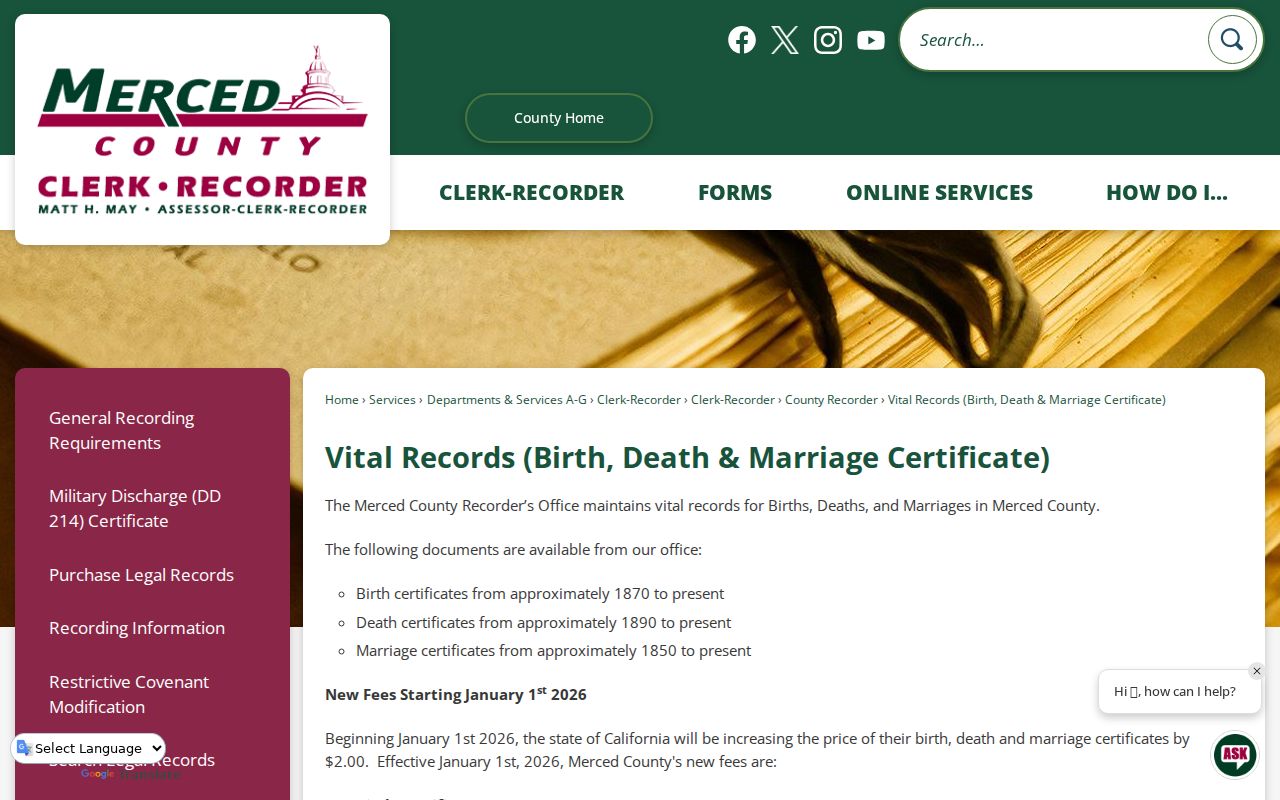
The form and coverage route matter when a family-history clue needs an official copy.
Federal Records Extend Los Banos History
A Los Banos address trail can cross into federal court or census records when a former owner, heir, or creditor appears outside county files. PACER searches federal cases by party, case number, and court. The fee is generally ten cents per page, with a three-dollar document cap and a quarterly waiver when charges are thirty dollars or less. Sealed cases and redacted identifiers remain unavailable.
Federal court records are not a replacement for Merced deeds or directories. Use a party name, court, and date to test a specific lead, then match the result with a parcel, family, or probate clue. A bankruptcy or federal filing may explain an ownership event, but it does not by itself establish who lived at the house.
The official PACER site is the federal access route for a case or party lead connected to a Los Banos house history.
Federal records add a narrow event or party clue, while the local deed and household sources remain the core trail.
The PACER account and access page is also the source for federal party and case search information.
Use the federal route only for a specific lead, and keep its fees, redactions, and sealed-file limits with the result.
Los Banos Previous Residents and Copy Costs
Access changes by source. Recorder index inspection is free, public kiosk viewing is free, and copies or certification are charged under the county fee schedule. Vital applications have county and state fees, with possible online handling or delivery charges. Court copies and certifications follow court guidance, and federal PACER pages can carry a small per-page charge. Check the current custodian fee page before sending money.
A free index is not the same as a free image, and a catalog entry is not the same as open access. Ask the office or library for the exact record type, page, date, and payment route. A narrow request is easier to answer than a request for “everything about the house.”
The Merced County fee schedule is the official place to check recorder, vital, map, and copy charges. Cost and access notes help a house-history plan stay practical when a record moves from online index to counter or order.
The Merced County fee schedule is the source for current recorder, vital, map, and copy-charge guidance.
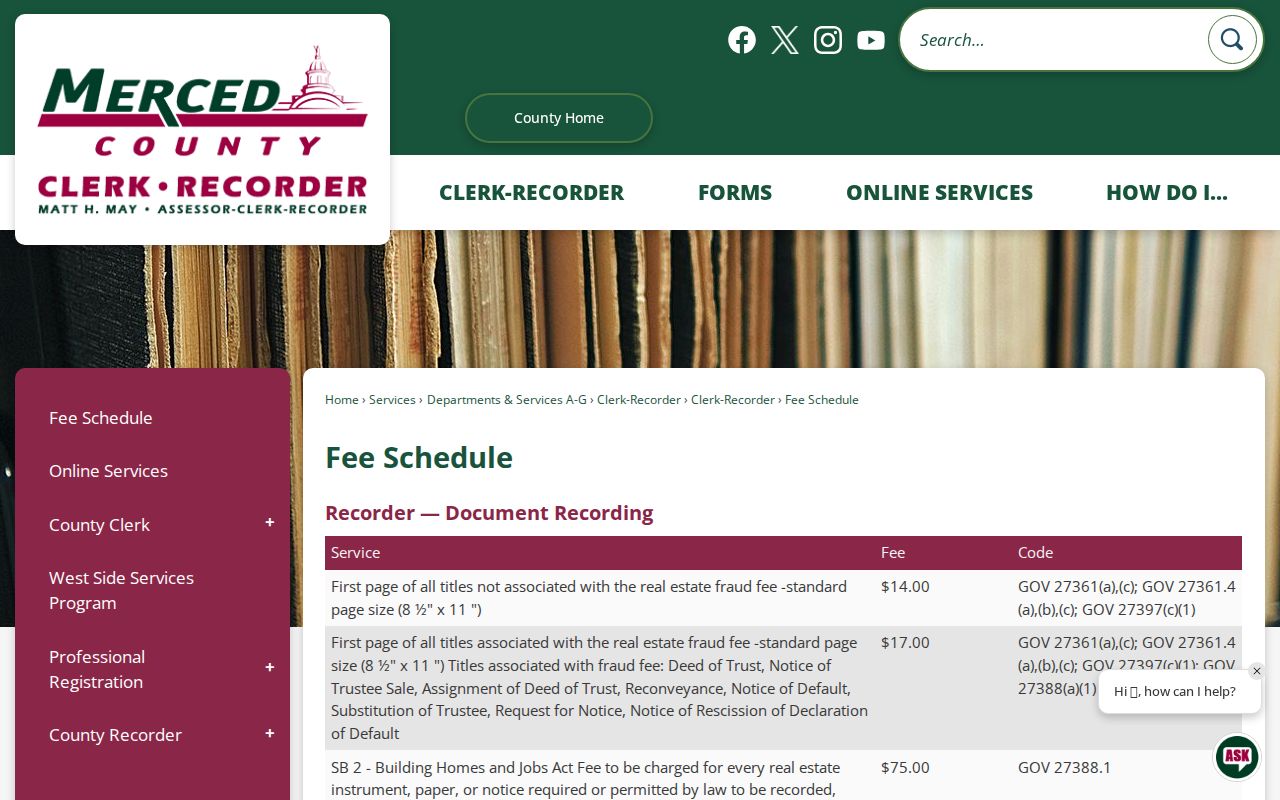
Check the current amount and accepted payment route before sending a request for a historical copy.
Past Los Banos Households: Census and Obituaries
Owners are only part of the previous-resident story. Directories and census schedules can show occupants, spouses, and household neighbors, including people who never owned the parcel. Obituaries and cemetery records can add kin and a later place, while probate and a deed can explain the final transfer. Keep the collection title, edition, page, address, and source date with every note.
Search both Los Banos and Los Baños, check the street section when present, and preserve a missing entry as a gap. Pair a directory year with the nearest census snapshot, then test the address against the APN, deed, map, and permit trail. The Los Banos by-street records page handles the modern address chain; this page keeps the backward household path.
Lawful house history. Research into previous residents is appropriate for family history, preservation, and personal curiosity. Do not use a Los Banos past-resident trail to track, stalk, harass, intimidate, or harm a living person.
The California Safe at Home program explains why an address may be substituted or withheld in a public-facing record.
A substitute mailing address is a protection, not a clue to work around while tracing a past household.
A well-built house history can say who appears in a dated record, who held an interest, and what source may explain the next gap. It should not claim that a directory omission or a deed party proves everyone who lived there.